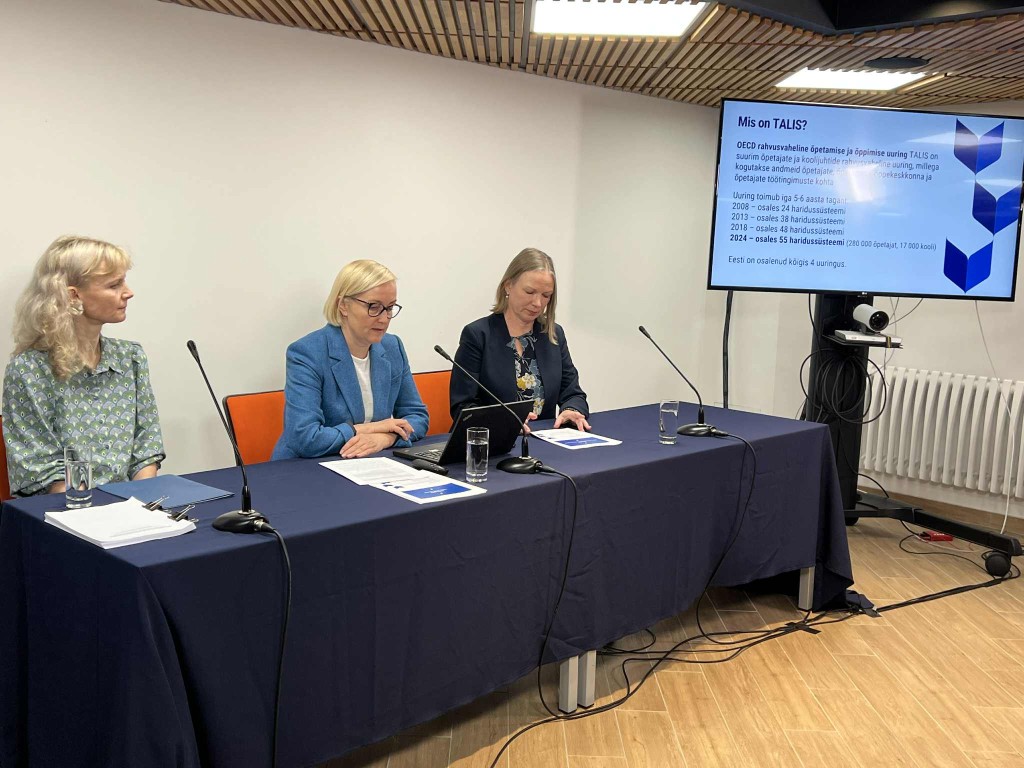
Minister Kristina Kallas stated that the results confirm that our teachers are well-educated professionals who themselves value their profession. “Teachers’ concerns include heavy workload, low societal recognition, and salary issues — topics we are addressing continuously. We are implementing a career model and a system of certification for school leaders; in cooperation with universities we are developing flexible learning paths and offering in-service training to strengthen competences. Next year, salaries will also increase,” explained the minister. She added: “It is encouraging that despite high workload and higher salary expectations, still 93% of Estonia’s 7th–9th grade teachers are broadly satisfied with their profession and 87% enjoy working in schools.”
Compared with 2018, Estonia’s school student population is more diverse linguistically, culturally, and in terms of learning needs, including children arriving from Ukraine. Teachers wish to participate more in professional development on teaching in multicultural and multilingual environments, to build their competences and confidence in teaching and adapting instruction for students with different needs. They also see a need for professional development on the use of artificial intelligence (AI) to increase their confidence in employing AI in teaching and reduce workload. Over one third of teachers have already used AI assistance in their teaching.
Despite greater classroom diversity, Estonian teachers are among the best in maintaining class discipline compared to other countries, and they are able to devote 84.3% of instructional time to teaching and learning. Among the participating countries, our teachers spend the least amount of class time on maintaining order.
Compared with 2018, the workload of teachers has increased, as has the share of teachers reporting high or considerable stress. The greatest sources of stress for Estonian teachers are responsibility for students’ learning outcomes and for students’ social and emotional well-being, as well as adapting lessons for students with special educational needs.
One concern, according to school leaders, is the lack of qualified teachers and support specialists. Estonia also stands out with a high risk of attrition: 45.5% of teachers intend to remain in the profession for no more than five more years. The intention to leave is strongly associated with salary, working conditions, overall job satisfaction, perceived recognition, and high stress levels.
On the positive side, 99% of teachers say they like the subject(s) they teach; 92% often feel happy while teaching; and 93% confirm that the various challenges of the teaching profession provide them with satisfaction.
The TALIS survey is conducted by the OECD every six years. TALIS gives teachers and school leaders the opportunity to make their voices heard. The survey data help education policy makers understand what works and what needs to change. It is also a good opportunity to compare one’s education system with those of OECD member and partner countries and learn from them.
The conduct of the survey in Estonia was co-funded by the European Union through the Erasmus+ programme and the project “Initial and Continuing Training and Career Support in the Education and Youth Sector.”
The national report on Estonia’s results will be prepared in November in collaboration between the University of Tartu and Tallinn University. Introductory seminars will be held on 17 November in Tallinn and on 20 November in Tartu.